
Friction Friday: The Hidden Operational Forces That Quietly Limit Your Facility
Manufacturing leaders don’t wake up thinking about friction.
They think about throughput.
Labor.
Safety.
Deadlines.
Output per shift.
But friction is what determines whether those goals are achieved — or quietly undermined.
At BTB Solutions, Friction Friday started as a simple question:
Where does operational friction live inside your facility?
Over time, that question has revealed a consistent pattern: the biggest performance limitations are rarely dramatic failures. They’re small, persistent constraints that compound across the production line.
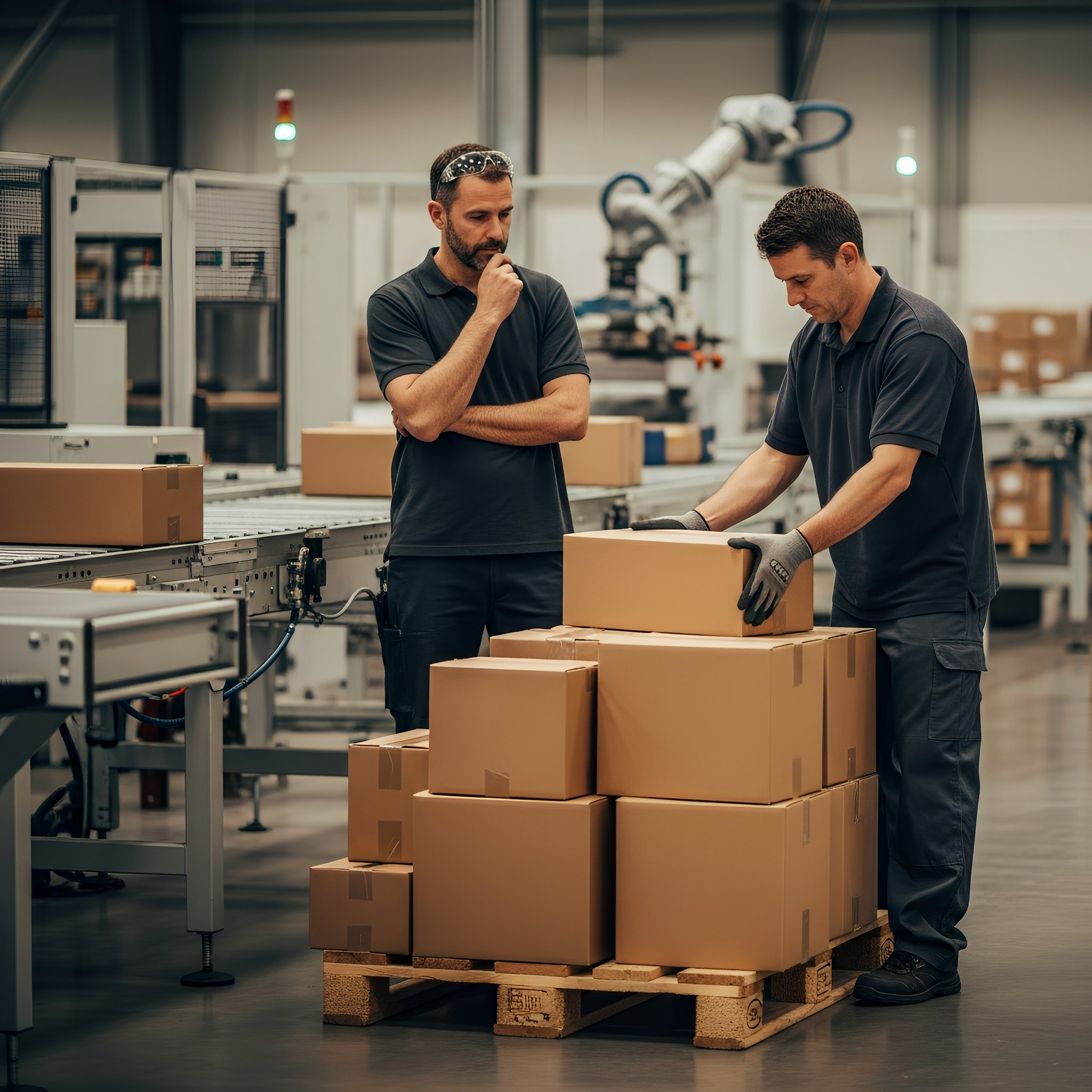
In a warehouse facility, a male worker stacks boxes on a pallet while a supervisor watches.
What Is Operational Friction?
Operational friction isn’t a breakdown.
It isn’t a catastrophic failure.
It’s the subtle resistance inside a system that:
Slows throughput under peak conditions
Increases reliance on overtime
Exposes teams to injury risk
Creates supervisory “firefighting”
Caps production capacity without anyone explicitly deciding to
Friction hides in plain sight.
And because it doesn’t always feel urgent, it often goes unaddressed — until volume spikes or labor tightens.
Why the Last 10 Feet of the Line Matters Most
In many food processing, fruit packing, and tree nut facilities, friction lives at the end of the line.
Sorting may be optimized.
Washing may be calibrated.
Packaging may run efficiently.
But palletizing?
It’s often treated as something that will “just work.”
The reality is this:
The final stage of production sets the ceiling for the entire operation.
If palletizing can’t keep pace:
Upstream processes slow down
Overtime increases
Shipping schedules tighten
Supervisors shift into reactive mode
Friction doesn’t announce itself — it compounds.
Friction Compounds During Peak Season
Seasonal operations — including fruit packing and tree nut processing — experience this more than most.
Hazelnut and almond processors on the West Coast understand this pressure well. During harvest windows, there is no margin for instability.
When labor becomes unpredictable or volume spikes exceed expectations, manual palletizing becomes a risk multiplier:
Fatigue increases injury exposure
Inconsistent pallet builds affect logistics
Line balancing becomes reactive instead of strategic
Peak season doesn’t create friction.
It exposes it.
Removing Friction Without Overhauling the Entire Facility
The solution to operational friction is rarely “automate everything.”
More often, it’s about identifying and stabilizing the constraint.
In palletizing, that might mean deploying a focused automation solution that:
Matches required throughput
Fits within existing footprint constraints
Integrates without lengthy downtime
Scales with seasonal demand
Systems like REAPR and Uno are often deployed specifically to address that final-stage instability — not to replace teams, but to remove variability.
When palletizing stabilizes, upstream processes operate more smoothly. Supervisory pressure decreases. Throughput becomes predictable.
The system breathes differently.
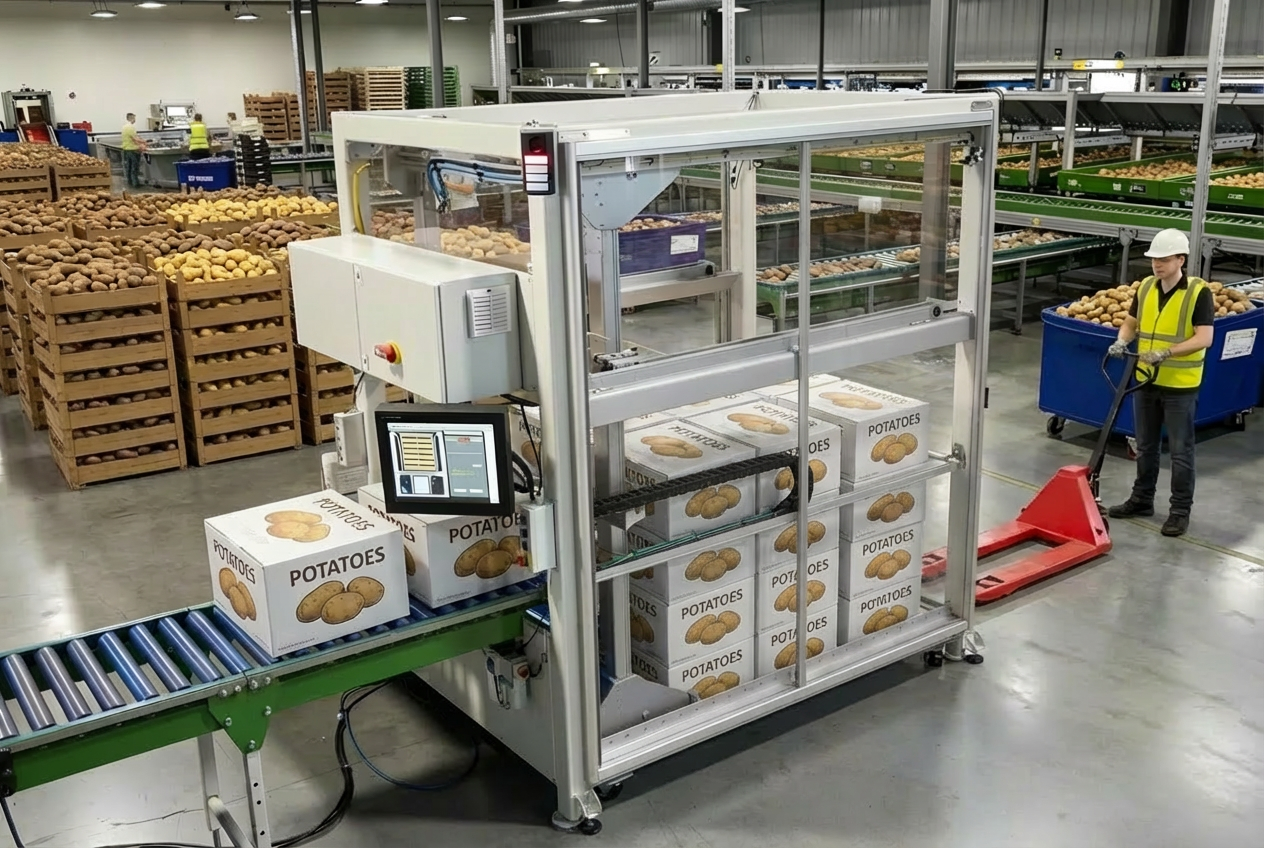
A worker moves a pallet into position to transport a pallet of potato boxes out of the Uno palletizer from BTB solutions
A Strategic Advantage: Aligning Automation With Seasonality
One of the most overlooked drivers of friction in agricultural operations is misalignment between production cycles and capital investment.
Not every facility needs automation 12 months a year.
That’s why seasonal palletizer rental has emerged as a practical solution for fruit and tree nut processors who need stability during peak harvest without long-term overhead.
By aligning automation with production cycles, facilities can:
Reduce labor volatility during high-pressure windows
Improve ROI by deploying equipment only when needed
Maintain flexibility in off-season operations
Automation becomes strategic — not permanent.
Friction Is a Leadership Question
Ultimately, operational friction is not just a mechanical issue.
It’s a leadership decision.
It’s the difference between:
Reacting to instability
Or designing it out
Between:
Hoping the line holds under pressure
Or knowing it will
The facilities that consistently outperform during harvest aren’t necessarily the ones with the most automation.
They’re the ones that understand where friction lives — and remove it deliberately.
The Question That Drives Friction Friday
Each week, Friction Friday asks a simple but revealing question:
Where is the constraint that quietly limits your performance?
For many facilities, the answer isn’t obvious until peak demand arrives.
By then, the cost of friction has already compounded.
If you’re evaluating throughput, labor stability, or peak-season risk, it may be worth looking at the final stage of your line.
Because often, the last 10 feet determine everything that happens before it.