
The ROI of Automating Your End-of-Line Palletizing Process
When manufacturers evaluate automation investments, they often start upstream — processing, packaging, filling, or assembly.
But in many facilities, the fastest return on investment isn’t found at the beginning of the line.
It’s found at the end.
End-of-line palletizing automation is one of the most overlooked — and most financially impactful — upgrades a facility can make. Not because it’s flashy, but because it stabilizes the final stage of production, where small inefficiencies quietly cap throughput, inflate labor costs, and increase operational risk.
This article breaks down how to evaluate the real ROI of automating your palletizing process — without relying on equipment pricing assumptions.
What Is End-of-Line Palletizing Automation?
End-of-line palletizing automation refers to the use of robotic or automated systems to stack finished products onto pallets at the final stage of a production line. Instead of relying on manual labor, automated palletizers organize, align, and build consistent pallet loads for storage or shipment. This improves throughput, reduces labor dependency, enhances workplace safety, and stabilizes overall manufacturing operations.
1. The Cost of Manual Palletizing in Manufacturing Operations
Before calculating ROI, it’s important to understand the baseline.
Manual palletizing introduces:
Direct labor costs per shift
Overtime during production spikes
Injury exposure and workers’ compensation claims
Throughput limitations tied to fatigue
Supervisory time spent managing instability
Most facilities don’t view palletizing as a financial drain because the costs are distributed across departments.
But when you annualize those costs, the exposure becomes clear.
If your facility runs:
2–4 palletizing positions per shift
Across 2–3 shifts
At fully burdened labor rates
Including overtime during peak demand
The annual labor exposure alone can be significant — before even considering indirect costs.
2. How Automated Palletizing Reduces Labor Costs
The most straightforward ROI calculation involves labor.
Key inputs to evaluate:
Number of palletizing employees per shift
Fully burdened hourly rate (wages + benefits + payroll taxes)
Overtime percentage
Turnover and training costs
Automation does not necessarily eliminate jobs. In many facilities, it allows labor to be reallocated to higher-value tasks while stabilizing output.
Even partial labor reduction or overtime elimination can materially shift annual operating costs.
3. How Palletizing Automation Increases Throughput
In many operations, palletizing becomes the quiet bottleneck.
When palletizing falls behind:
Upstream production slows
Line balancing becomes reactive
Shipping windows tighten
Finished goods staging becomes congested
This creates a ceiling on production capacity.
Automating end-of-line palletizing often unlocks throughput that already exists upstream. That recovered capacity can translate into:
Increased daily output
Faster order fulfillment
Growth without expanding footprint
Reduced need for additional shifts
This is not just cost reduction. It’s capacity expansion without facility expansion.
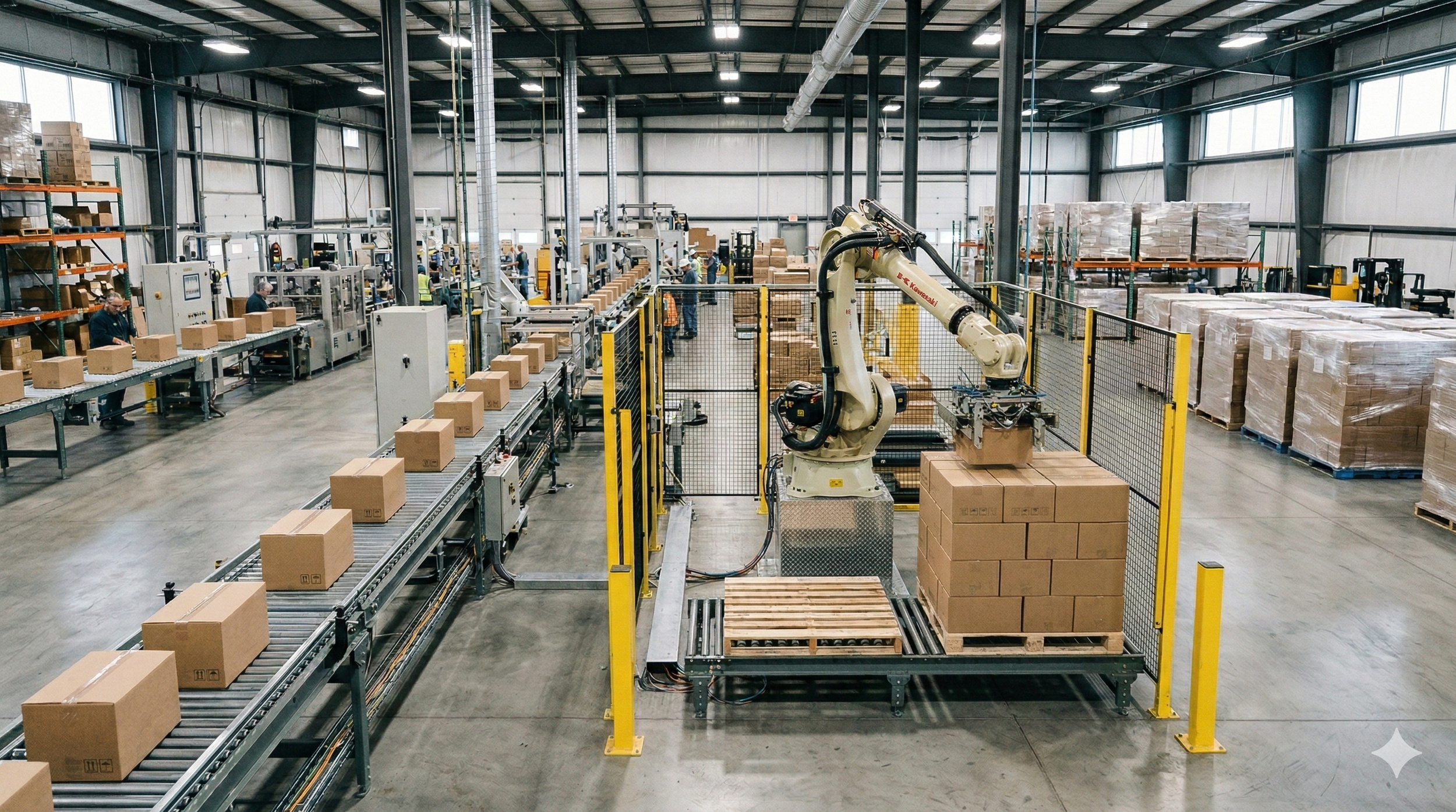
A robotic palletizer has been placed, ready for the production line to utilize it’s capabilities.
4. Reducing Workplace Injuries with Automated Palletizing
Manual palletizing is physically demanding and repetitive.
Facilities must consider:
Repetitive strain injuries
Back and shoulder injuries
Lost time incidents
Workers’ compensation premium impact
Temporary replacement labor
Injury-related costs rarely appear in ROI spreadsheets — but they are real and compounding.
Automated palletizing reduces exposure by removing repetitive heavy lifting from the process.
For many leadership teams, this alone strengthens the business case.
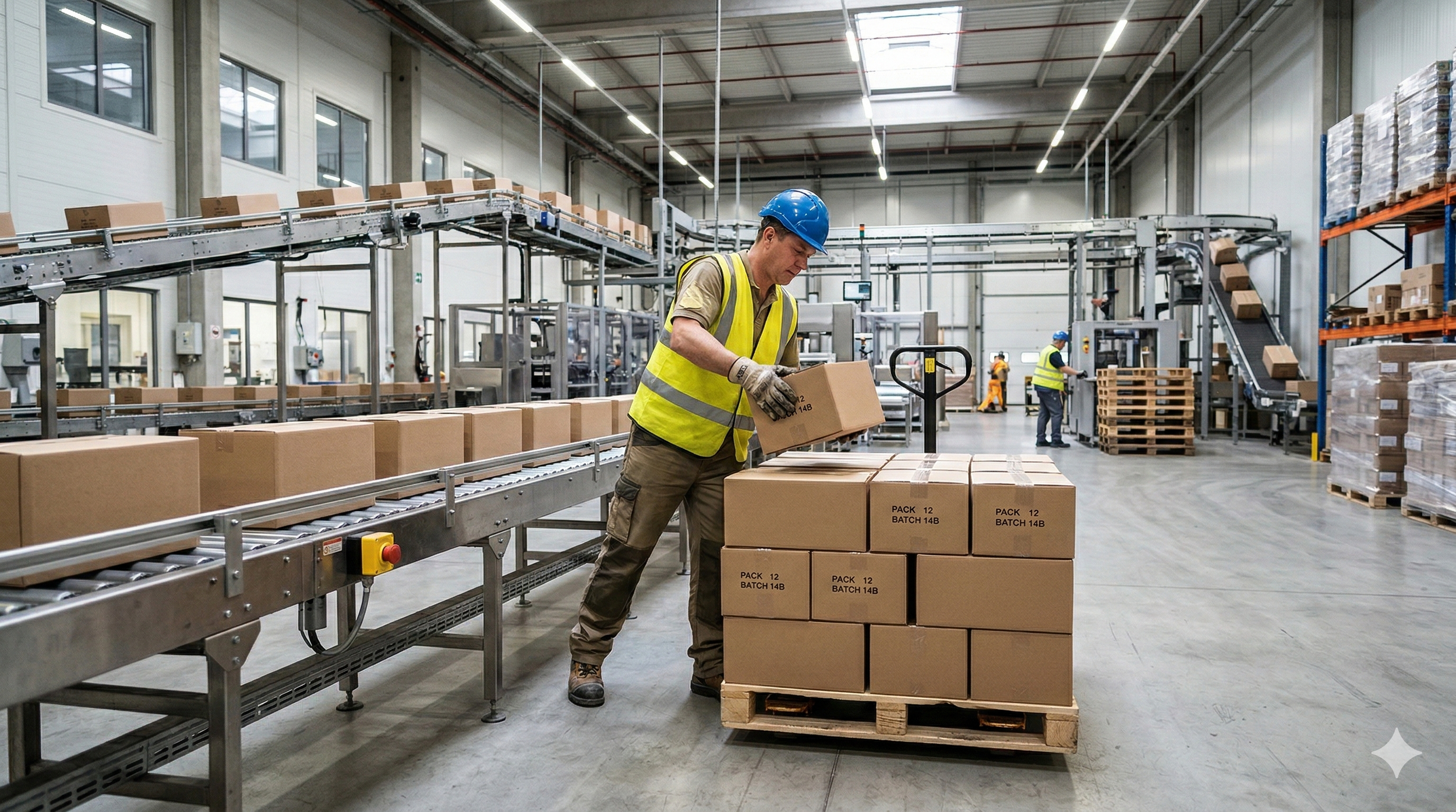
A male worker pulls boxes off a conveyor line and manually stacks them on a pallet.
5. Aligning Palletizing Automation with Seasonal Production
For operations with production peaks — whether driven by market demand, promotional cycles, or harvest windows — palletizing instability compounds quickly.
During peak demand:
Overtime increases
Hiring becomes reactive
Training windows shrink
Supervisory pressure rises
Seasonal automation deployment, including palletizer rental options, allows facilities to align capital investment with production cycles.
This accelerates payback while reducing long-term risk.
Instead of owning underutilized equipment, facilities deploy automation when it creates the most impact.
6. Visualizing the ROI Distribution
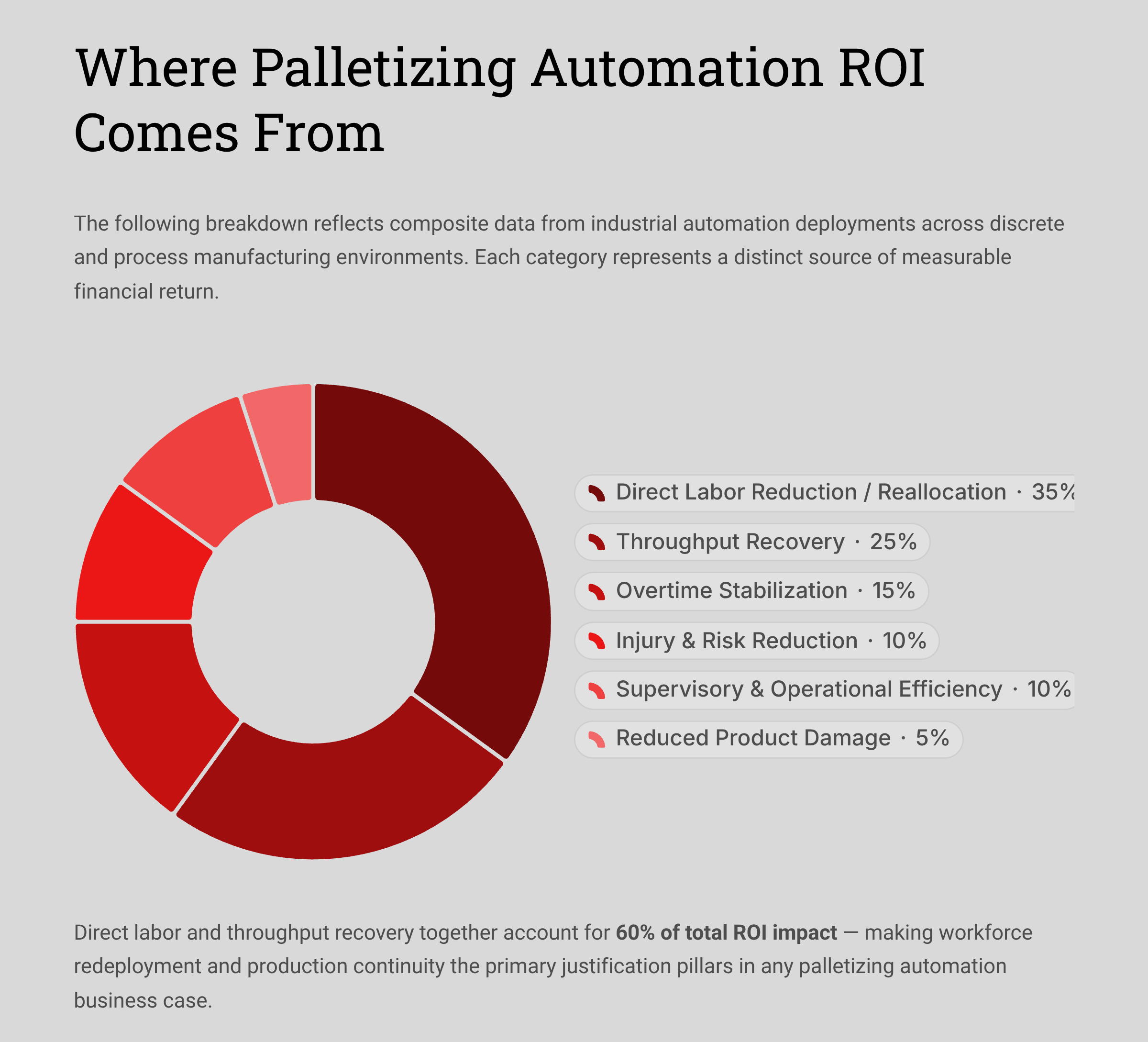
While direct labor reduction often drives the initial business case for palletizing automation, the total return on investment is rarely tied to a single factor. Stabilizing end-of-line operations impacts overtime exposure, throughput capacity, injury risk, and overall operational efficiency simultaneously. The financial impact is cumulative — small gains across multiple categories compound into measurable, sustainable ROI.
A helpful way to think about palletizing automation ROI is by cost category.
For many facilities, total ROI impact is distributed across:
Direct labor reduction or reallocation
Overtime stabilization
Injury cost avoidance
Throughput recovery
Reduced product damage
Supervisory efficiency
7. Why End-of-Line Palletizing Automation Delivers Fast ROI
Unlike upstream automation, palletizing automation:
Requires less integration complexity
Impacts every finished product leaving the line
Stabilizes output immediately
Directly reduces labor volatility
Solutions such as REAPR and UNO are designed specifically for rapid deployment and operational flexibility — whether as permanent installations or seasonal deployments.
Because palletizing sits at the end of the process, improvements are immediately measurable in output, labor hours, and shipment stability.
8. How to Calculate ROI for Palletizing Automation
To calculate your own ROI exposure, start with:
Annual palletizing labor hours
Fully burdened labor rate
Overtime percentage
Injury history and associated costs
Current throughput constraints
Peak demand instability
Then ask:
If palletizing were stabilized tomorrow, what changes?
Would upstream lines run faster?
Would overtime drop?
Would supervisors shift from firefighting to optimizing?
Would growth require less capital expansion?
That delta is where ROI lives.
Final Thought: The End of the Line Determines the Outcome
Palletizing may be the last stage of production — but financially, it is often the first opportunity for return.
End-of-line palletizing automation reduces labor risk, unlocks throughput, improves safety, and stabilizes operations across industries including food processing, manufacturing, distribution, and industrial packaging.
The question isn’t whether automation costs money.
The question is:
What is instability currently costing your operation?